

When electronic equipment is powered on, the input capacitor inside a switching power supply requires a large amount of current to charge in a very short time. This sudden current spike is called inrush current. Although it only lasts for a short period, it can create stress on components such as fuses, bridge rectifiers, switches, relays, and power semiconductors.
To control inrush current, engineers usually choose between NTC thermistors and fixed resistors. Both methods add resistance to the charging path and reduce the initial current, but their performance during normal operation is different.
Fixed Resistor for Inrush Current Limiting
A fixed resistor limits current by providing a constant resistance in the circuit. According to Ohm's law (I = V/R), increasing resistance reduces the initial charging current of the capacitor.
However, the resistance value remains unchanged after startup. This means the resistor continues to consume power during normal operation, generating continuous heat and reducing system efficiency. Fixed resistors are generally suitable for low‑power applications where energy loss and heat generation are less critical.
NTC Thermistor for Inrush Current Limiting
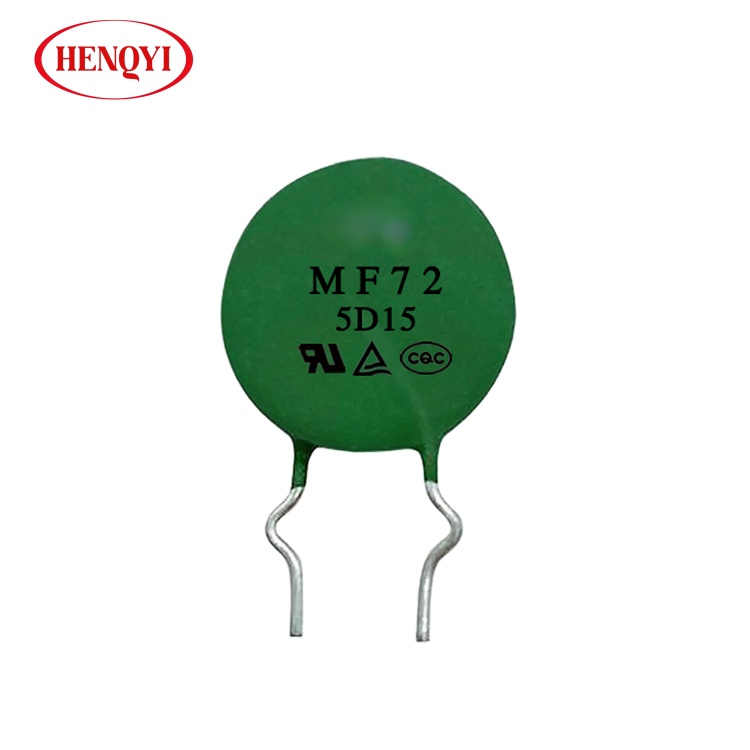
An NTC thermistor uses a temperature‑dependent resistance characteristic to provide dynamic current control. At startup, the NTC is at a lower temperature and has a higher resistance, which limits the charging current of the input capacitor. As current flows through the thermistor, it heats up and its resistance decreases. The circuit then operates with lower resistance and reduced power loss.
Compared with a fixed resistor, an inrush current limiter can provide effective startup protection while maintaining better efficiency during normal operation. This makes it widely used in switching power supplies, adapters, chargers, UPS systems, LED drivers, industrial power supplies, and energy storage equipment.
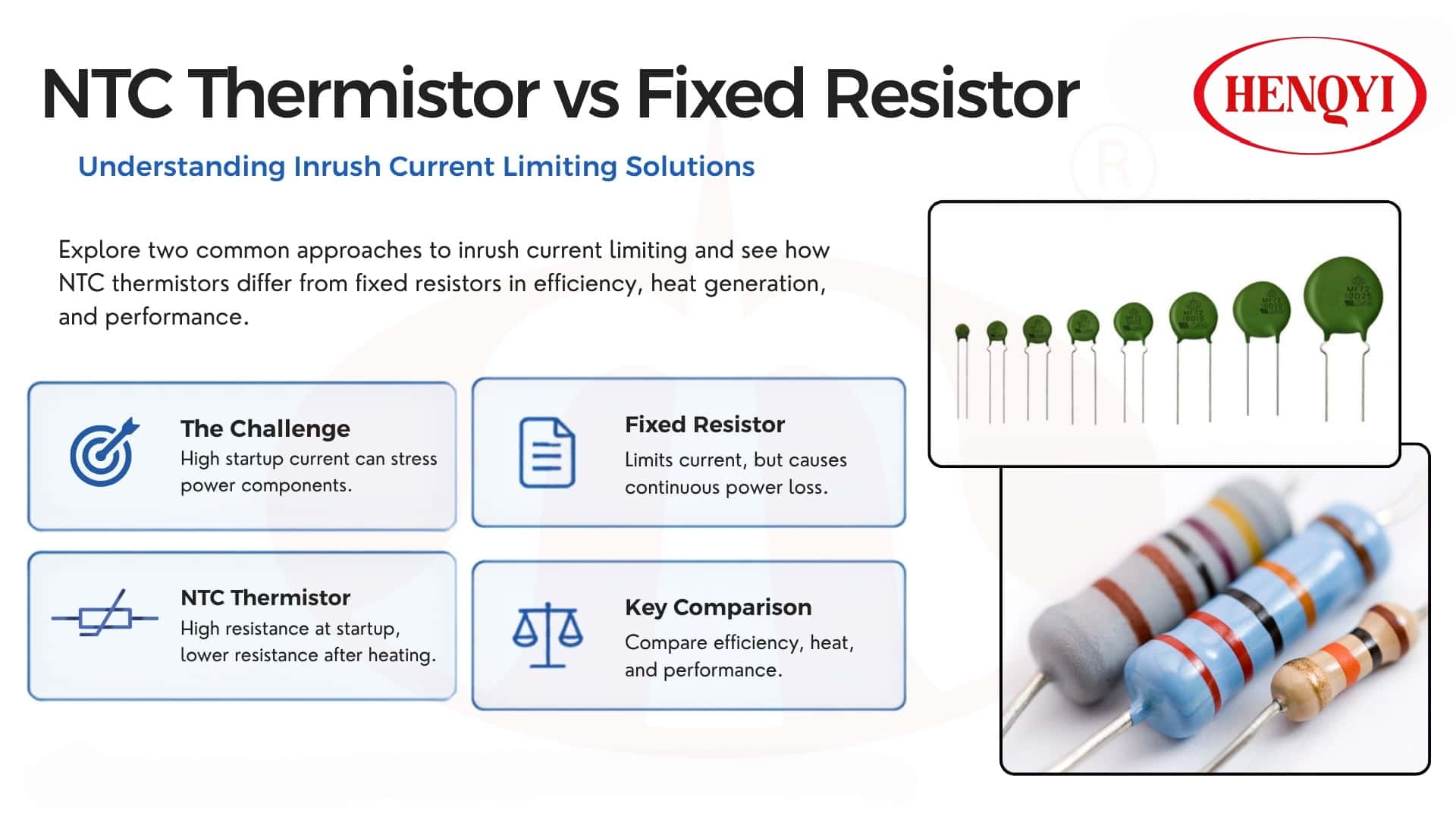
NTC Thermistor vs Fixed Resistor: Key Differences
| Feature | NTC Thermistor | Fixed Resistor |
|---|---|---|
| Resistance change | Changes with temperature | Constant |
| Startup current control | High resistance limits surge | Fixed resistance limits current |
| Normal operation | Low resistance, lower power loss | Continuous power consumption |
| Heat generation | Mainly during startup | Continuous |
| Efficiency | Higher | Lower |
| Typical applications | Power supplies, chargers, UPS, industrial equipment | Low‑power circuits |
How to Select a Power NTC Thermistor
Choosing the right power NTC thermistor depends on the actual circuit conditions. Important parameters include:
- Initial resistance – determines the startup current limitation capability
- Maximum steady‑state current – ensures safe continuous operation
- Energy rating – defines the ability to handle startup pulses
- Thermal characteristics – affects response and recovery performance
- Operating environment – including temperature, ventilation, and installation conditions
Conclusion
Fixed resistors provide a simple way to limit inrush current, but they continue consuming power after startup. NTC thermistors offer a more flexible solution by providing high resistance during startup and lower resistance during normal operation.
For applications requiring reliable startup protection and improved energy efficiency, power NTC thermistors are widely used as an effective inrush current limiting solution. HENQYI Electronics provides customized power NTC thermistors for inrush current limiting, power protection, and high‑reliability electronic applications.